
The Issue
Most scientists expect that hurricanes will become more ferocious as greenhouse gases build up in the atmosphere, but what does the faraway Arctic have to do with tropical storms? A lot, it turns out.
Why It Matters
Major hurricanes can be deadly and ruin the livelihoods of millions, while causing billions of dollars in damages. Evidence is mounting that the rapidly changing Arctic is affecting tropical storms, but more research is needed to determine how and how much. The devastating 2017 hurricane season highlights the urgency of such research.
State of Knowledge

Scientists have long suspected that hurricanes would strengthen in a warming world. It's basic physics. Warmer air contains more energy, and tropical storms can turn that energy into stronger winds. More important is that most of the heat trapped by greenhouse gases ends up in the ocean. Warmer oceans are like a supercharged battery for tropical storms. Additional heat in the water and air also leads to more evaporation, and that extra water vapor fuels storms as it condenses into clouds and releases energy into the air. And warmer oceans take up more space, accounting for about half of the observed rise in global sea level. A hurricane's storm surge and destructive waves ride on an increasingly higher sea, exacerbating the destruction and moving it farther inland.
The Arctic's role in this story is as an ampliIier. Arctic ice has been disappearing at an alarming and unprecedented rate during recent decades. There is no plausible explanation for this change other than human-caused global warming. Because the Arctic ice and snow are bright, most of the sun's energy that hits them is reIlected right back out to space, so it never enters the Earth's climate system. Losing those bright surfaces means the planet gains more energy. This may sound like a good thing, but in the story of global warming and tropical storms, it's anything but. Increasing the amount of greenhouse gases in the atmosphere by itself warms the Earth – just like putting an extra blanket on your bed. Melting ice means that the globe absorbs a larger fraction of the sun's heat, amplifying the warming caused by that extra blanket by about 25%1. Bottom line: Arctic ice loss is responsible for additional ocean warming, more fuel for storms, and faster sea-level rise. This much we do know.
Where the Science is Headed
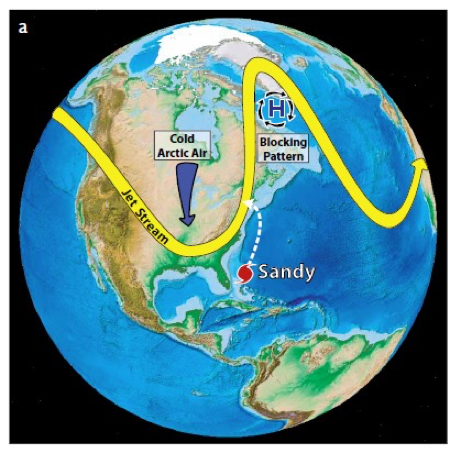
Another possible connection between Arctic change and unruly tropical storms has emerged in recent studies: impacts on storm-steering winds. Think Hurricane Sandy's left turn into New Jersey and Hurricane Harvey's stagnation over Houston. One effect of rapid Arctic warming is to favor so-called blocking events in the North Atlantic – large northward swings in the upper-level winds that can form large clockwise eddies in the Ilow. A persistent block was in place near Newfoundland just as Sandy tracked up the U.S. east coast in late October 2012 (Fig. 1). The strong eastward winds south of the block sent the storm on its unusual left hook into the mid-Atlantic. Some evidence suggests these types of blocks have been increasing in recent decades, especially in fall2. Another new study Iinds that steering winds over North America will weaken and become wavier in August3; both effects could increase the likelihood of stalled storms and the prodigious rain totals like those dumped on the Houston area by Harvey. An increasing tendency for conditions leading to stationary jet-stream waves during summer has also been suggested4, which could favor more unruly behavior of tropical storms.
While efforts continue to identify the various ways that rapid Arctic warming may affect the strength and paths of tropical storms, the evidence to date suggests that hurricanes will become more powerful, their tracks more erratic, and their impacts more destructive in a warming world.
Key References
Pistone, K., I. Eisenman, and V.
Ramanathan. 2014. Observational determination of albedo decrease caused by vanishing Arctic sea ice. U.S. Proc. Nat. Academ. Sci., 111, doi: 10.1073/pnas.1318201111.Hanna, E., T.E. Cropper, R.J. Hall, and J. Cappelen. 2016. Greenland Blocking Index 1851–2015: a regional climate change signal. Int. J. Climatol., 36, doi: 10.1002/joc.4673.
Vavrus, S.J., F. Wang, J. Martin, J. Francis, Y. Peings, and J. Cattiaux. 2017. Changes in North American atmospheric circulation and extreme weather: InIluence of Arctic ampliIication and northern hemisphere snow cover. J. Climate, 30, doi: 10.1175/JCLI-D-16-0762.1.
Mann, M.E., S. Rahmstorf, K. Kornhuber, B.A. Steinman, S.K. Miller, and D. Coumou. 2017. InIluence of anthropogenic climate change on planetary wave resonance and extreme weather events. Nature ScientiIic Reports, 7, doi:10.1038/srep45242.
Greene, C.H., J.A. Francis, and B.C. Monger. 2013. Superstorm Sandy: A series of unfortunate events? Oceanography 26(1):8–9, http://dx.doi.org/10.5670/oceanog. 2013.11.
Contacts for further information
Jennifer Francis, Rutgers University
francis [at] marine.rutgers.edu
| Attachment | Size |
|---|---|
| aa012_july_2018_arctic_meltdown.pdf218.08 KB | 218.08 KB |