
The Issue
The rapid loss of floating Arctic sea ice is striking in its impact on global climate.
Why it Matters
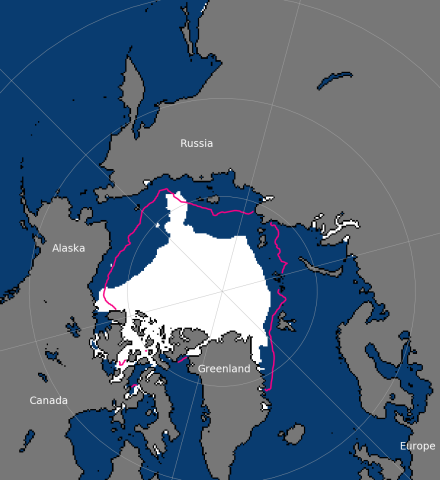
Snow-covered sea ice is one of the most reflective natural materials on Earth. As the area covered by sea ice dwindles, more sunlight is absorbed by the Arctic Ocean instead of being reflected back to space. The enhanced surface warming melts even more ice, which further reduces the reflectivity: a self-perpetuating cycle (1). As such, sea ice loss has strongly contributed to accelerated warming in the Arctic, where temperatures are increasing at two to three times the rate of the globe as a whole.
State of Knowledge
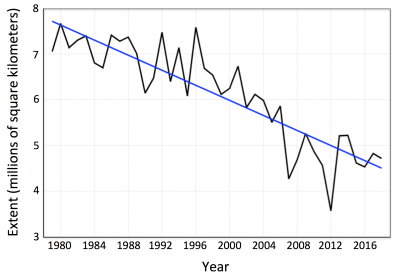
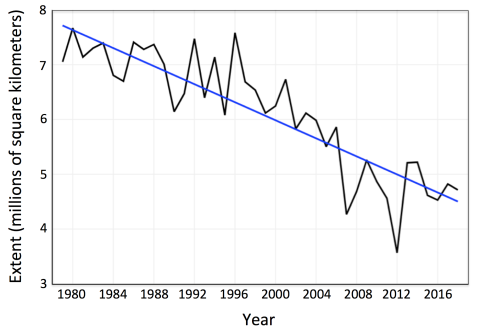
Since the onset of satellite measurements in 1979, Arctic sea ice cover has diminished significantly in all months. The trends are largest in September when the ice cover is at its seasonal minimum (see figure at right), with ice loss rates currently exceeding 10% per decade. The declines in area covered by ice are accompanied by a rapid thinning of the ice, with over 60% of the ice volume lost in only 30 years (2). Startling reductions in recent years—2007 and 2012 in particular—contributed to the accelerated trend in ice loss. The accelerating loss, accompanied by ice thinning and strong reinforcing feedbacks, suggests that the characteristics and behavior of Arctic sea ice are now fundamentally different than they were in the 20th century. This diminished Arctic sea ice has widespread implications for ecosystems, coastal erosion, and human activities in the region.
Climate models project further increases in the rate of ice loss punctuated by intervals of especially rapid change, such as observed in 2007 and 2012 (3). The models indicate that instances of rapid sea ice loss have subsequent impacts on atmospheric warming, permafrost thaw, and Arctic cloudiness resulting in large-scale changes to global climate. Climate models also indicate that sea ice could increase for several years at a time when natural cooling counteracts human-induced warming (4). Despite possible short-lived periods of cooling, climate models project an overall trend of continued ice loss and enhanced Arctic warming over several decades. Unless the burning of fossil fuels is considerably reduced, it is highly likely that most of the Arctic Ocean will be ice-free in summers later this century.
Average monthly Arctic sea ice extent in September, 1979-2018
(Credit: National Snow and Ice Data Center)
Where the Science is Headed
While the long-term prospect for Arctic sea ice is one of continued loss, shorter-term fluctuations on seasonal to inter-annual timescales are important for ecosystems and human activities in the region. Predicting sea ice fluctuations from one season to the next is a challenging task, and models project greater seasonal variation in the area covered by ice as it becomes thinner. Fortunately, there are promising advances in the predictive capabilities of sea ice models that will improve forecasts and reduce risks for a variety of stakeholders.
Key References
- Perovich, D.K., J.A. Richter-Menge, K.F. Jones, and B. Light, 2008. Sunlight, water, and ice: Extreme Arctic sea ice melt during the summer of 2007, Geophysical Research Letters, 35, L11501, doi: 10.1029/2008GL034007.
- Lindsay, R. and A. Schweiger, 2015. Arctic sea ice thickness loss determined using subsurface, aircraft, and satellite observations, The Cryosphere, 9, doi: 10.5194/tc-9-269-2015
- Stroeve, J.C., V. Kattsov, A. Barrett, M. Serreze, T. Pavlova, M. Holland, and W.N. Meier, 2012. Trends in Arctic sea ice extent from CMIP5, CMIP3, and observations, Geophysical Research Letters, 39, doi: 10.1029/2012GL052676.
- Kay, J.E., M.M. Holland, and A. Jahn, 2011. Inter-annual to multi-decadal Arctic sea ice extent trends in a warming world. Geophys. Res. Lett., 38, L15708, doi:10.1029/2011GL048008.
Contacts for further information
Marika Holland
National Center for Atmospheric Research mholland [at] ucar.edu
Walt Meier
NASA Goddard Space Flight Center walt.meier [at] nasa.gov
| Attachment | Size |
|---|---|
| aa-004-future-sea-ice-loss.pdf751.74 KB | 751.74 KB |