
The Ecology and Evolutionary Biology Program (http://www.dartmouth.edu/~biology/eeb/index.html) encompasses all areas of ecology, evolutionary biology, and related disciplines.
With funding from the U.S. Department of Agriculture, NSF, and others, Matthew Ayres studies the causes of spatiotemporal patterns in the abundance of forest insects and pathogens. One of his interests is the impact of climate change on biotic disturbance regimes. In August 2009, Ayres and graduate student Lauren Culler investigated entomofauna and aquatic habitats near Kangerlussuaq, Greenland. They installed iButton data loggers to record temperature at set intervals in order to study climatic gradients in aquatic habitats from the ice sheet down to a fjord. Culler is using these data to design experiments that test the mechanisms by which climate change affects freshwater insects. She received a Harp Fellowship from the Institute of Arctic Studies to facilitate her research.
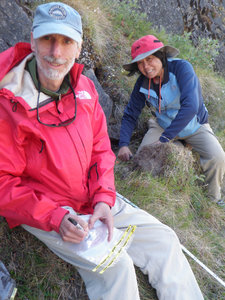
Ross Virginia (at left) and Xiahong Feng (at right) collecting soils on a south-facing slope in West Greenland to examine soil carbon storage and vegetation interactions. Photo by Simone Whitecloud.
Graduate student Simone Whitecloud works with ecology professor Mark McPeek studying plant interactions in arctic and New England alpine systems and how climate change affects these dynamics. Thirty percent of alpine species are also found in the Arctic. One of Whitecloud's current projects compares abiotic factors—temperature, wind, and growing season—in alpine and arctic plant communities as controllers of plant community composition. As part of this research, Whitecloud briefly worked in Greenland last summer preparing for an extensive sampling of plants there in summer 2010. She is also researching the effects of climate change on indigenous populations who are subsistence hunters and depend on arctic plants as food for large grazers.
Ross Virginia, director of the Institute of Arctic Studies, is an ecosystem ecologist interested in human influences on biogeochemical cycles. His research involves understanding how climate change alters soil biodiversity and plant-soil interactions in high latitude ecosystems and examination of carbon and nitrogen cycling in the polar deserts of Antarctica. He is a lead investigator on the McMurdo Dry Valleys Long Term Ecological Research (LTER) Program and is principal investigator on Dartmouth's NSF-funded Integrative Graduate Education and Research Traineeship (IGERT) Polar Environmental Change Program, which facilitates interdisciplinary graduate education and research related to the science and human dimensions of rapid environmental change in high latitudes. He is also involved with studies of the relationships between ecosystem science, environmental law, and policy.